The problem
AI agents can do work. Organizations can't yet trust them with it.
Authority is implicit
Who authorized it, in what scope, with which tools?
Self-review is weak
A model shares its own blind spots.
Memory evaporates
Lessons are lost between sessions.
Acceptance is opaque
Who tested it, reviewed it, accepted the risk?
The missing piece is not a better agent. It is the organization around them.
Why now
The building blocks for organized AI work have converged.
Reasoning models
Plan and critique
Tool-using agents
Act on code and systems
Memory
Context across runs
Deterministic controls
Sandboxes, tests, version control
The vision
A parallel AI organization, derived from the business you already run.
Your business today
Parallel AI organization
Organization
Objectives and policies
Business units
Charter and budget
Roles
Duties and tools
AI organization
Under the same policy
AI business units
Delegated, scoped authority
AI role-holders
Permitted tools, review rules
Accountable humans
- Approve the mapping
- Own each AI unit and role
- Grant and revoke authority
- Keep release authority
Grows one function at a time. Mapping needs human validation; it never grants authority automatically.
Platform
Five building blocks, each with an honest status label.
- Internal use
- Used only by us, to build this platform.
- In Development
- Implementation incomplete or end-to-end capability not established.
- Roadmap
- Planned capability without demonstrated delivery; not a promise or a date.
- Vision
- The destination.
AuraForge Execution Engine (AFEE)
Each workstream gets its own Docker-sandboxed lane with an AI conductor.
In DevelopmentInternal use
AuraForge Memory Fabric (AFMF)
Run records, decisions and lessons, reviewed before they are reused.
In Development
LOOP Automation
Takes a bounded work package from plan to accepted outcome.
No complete governed end-to-end run published yet.
Status: In Development
Cross-family review
A model from a different family reviews each change; panels deliberate on hard calls.
In DevelopmentInternal use
AuraForge Foundry
Create and evolve a parallel AI organization from an approved business mapping.
Vision
No AuraForge product is generally available yet.
How it works
Builders, independent reviewers, test gates and Git.
Accountable human
Sets scope; accepts or rejects release
Coordinator
Splits work into bounded tasks
Parallel Docker-sandboxed lanes
Lane 1
Lane 2
Lane 3
Each: an AI conductor and a builder model.
Cross-family reviewers
A different model family
Test gates
Pass or fail, deterministically
Git state
Accepted work, evidence and memory
Findings or failures go back to the lane for remediation.
- 01Models never grade their own work
- 02Deterministic gates and a human decide acceptance
- 03Every state change is a Git commit
In DevelopmentInternal use
This is how the platform's own code is built today. It is not yet a complete governed end-to-end LOOP.
See it working
The lane monitor we build this platform with.
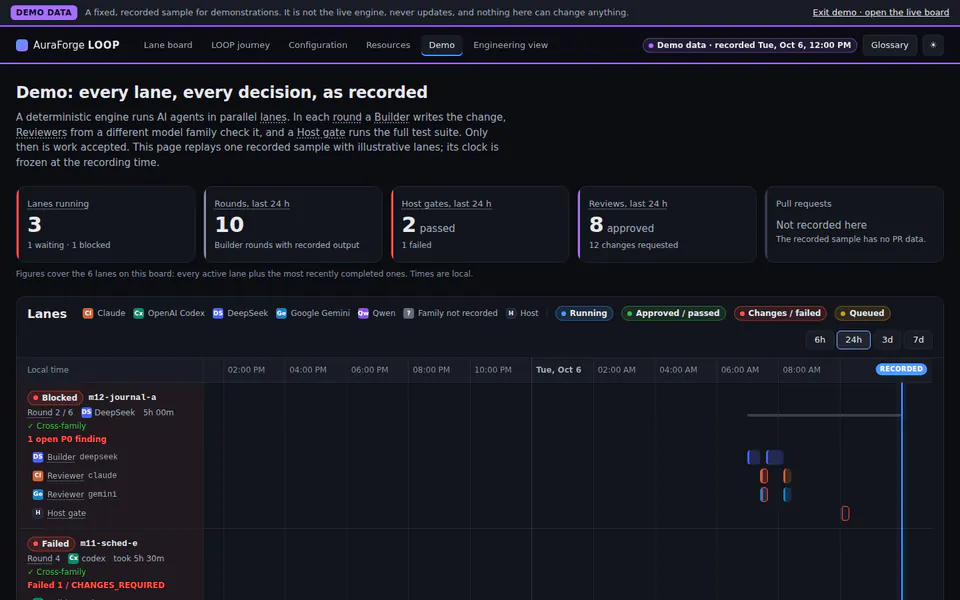
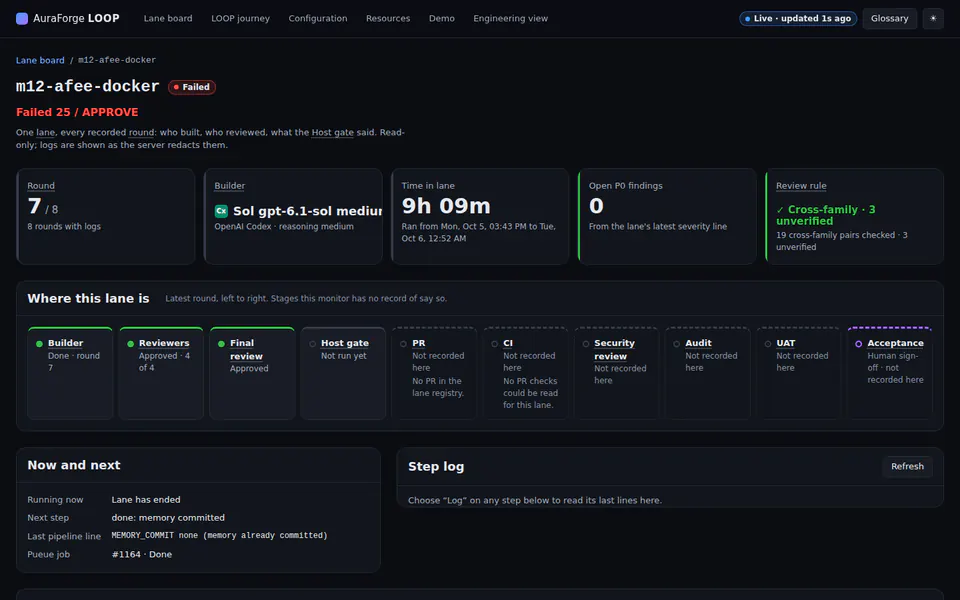
In DevelopmentInternal use
How we build
Built and reviewed by AI agent lanes.
Our private platform repository, as of 10 Oct 2026.
159
pull requests merged into main
1,333
commits; 971 carry an agent-lane prefix
8,559
Python test functions in 337 files
4
model families tag commits
| Lane / model family | Commits |
|---|---|
| DeepSeek[DeepSeek] [DSH] | 366 |
| OpenAI[Codex] | 350 |
| Anthropic[Claude] [Opus] | 210 |
| Pipeline automation[Pipeline] | 44 |
| Qwen[Qwen] | 1 |
| No prefix | 362 |
Evidence of how the platform is built, not of customer usage.
How we counted
PR count from the GitHub pull-request list (is:pr is:merged base:main, 10 Oct 2026). Commits, prefixes and tests from the git history of main at 86bae045, 22 Sep to 10 Oct 2026; commits exclude merges, and prefixes are read from commit subjects.
Tests are Python def test_ functions defined, not a pass count. Four model families tag commits; six are named in commit history, because Gemini and GLM appear in commit messages as reviewers and transports. Commands in README.md.
Roadmap
Two ladders: what we build, and how a business would adopt it.
Ladder A: what AuraForge is building
Foundation
Authority and execution boundaries
In Development
We are here
LOOP Automation
Bounded work packages
Status: In Development
Persistent AI Teams
Reusable roles
Roadmap
AI Business Units
A function with delegated authority
Roadmap
AI Organizations
Units under shared objectives
Roadmap
AuraForge Foundry
A parallel AI organization
Vision
Ladder B: how a business may adopt it (proposed path)
Map
Capture approved units and roles
Roadmap
Shadow
Observe and propose; no operational action
Roadmap
Assist
Propose actions; a human approves each one
Roadmap
Delegate
Act within bounded, revocable authority
Roadmap
Operate
A governed function, within its charter
Roadmap
Stages advance only on approved evidence; no dates are commitments. Adoption moves function by function and by risk. Delegation stays revocable, and Operate is not unrestricted autonomy.
Market
Software teams first, then business units.
01 Beachhead
Software teams
The way we already build this platform.
In Development
02 Next
Business units
Operations, support or finance, with human owners.
Roadmap
03 Destination
Organizations
Several AI business units working under organizational objectives, policy and human authority.
Vision
What these buyers need (design principles)
- Clear authority and audit trail
- Policy-constrained routing: local, private or approved external models
- Model, harness and deployment independence
- Human release authority
Sizing is deliberately qualitative: any organization with an operating design is a potential mapping input. These are design principles, not proven enforcement.
Company
Who builds AuraForge Foundry.
Bytesphere Technologies
AuraForge Foundry is built by Bytesphere Technologies (OPC) Pvt Ltd, a software company in India.
DPIIT Recognised Startup - Certificate No. DIPP274032
No AuraForge product is generally available yet.
Built on NVIDIA GPUs
We run open-weight models locally on NVIDIA GPU hardware. Local Qwen 3.8 27B inference serves our coding and review agents, alongside frontier models from cloud providers.
Contact
Talk to us about governed AI work.
Ask for a briefing on AuraForge Foundry and how we build with it.